 Acatenango Volcano Tours
What to Wear & What to Bring for the Acatenango Hike
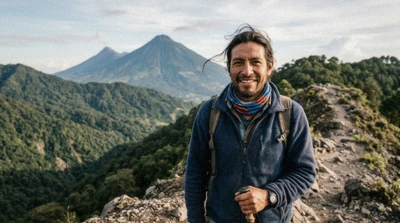
An Acatenango packing list is shorter than most people expect, because tours provide the tent or cabin, the sleeping bag and every meal; what's left on your list is layers, water and a headlamp. I check gear at the trailhead in La Soledad most weeks of the year, and the travelers I turn back for underpacking almost always made the same two mistakes: no real warm layer, and sneakers instead of boots.
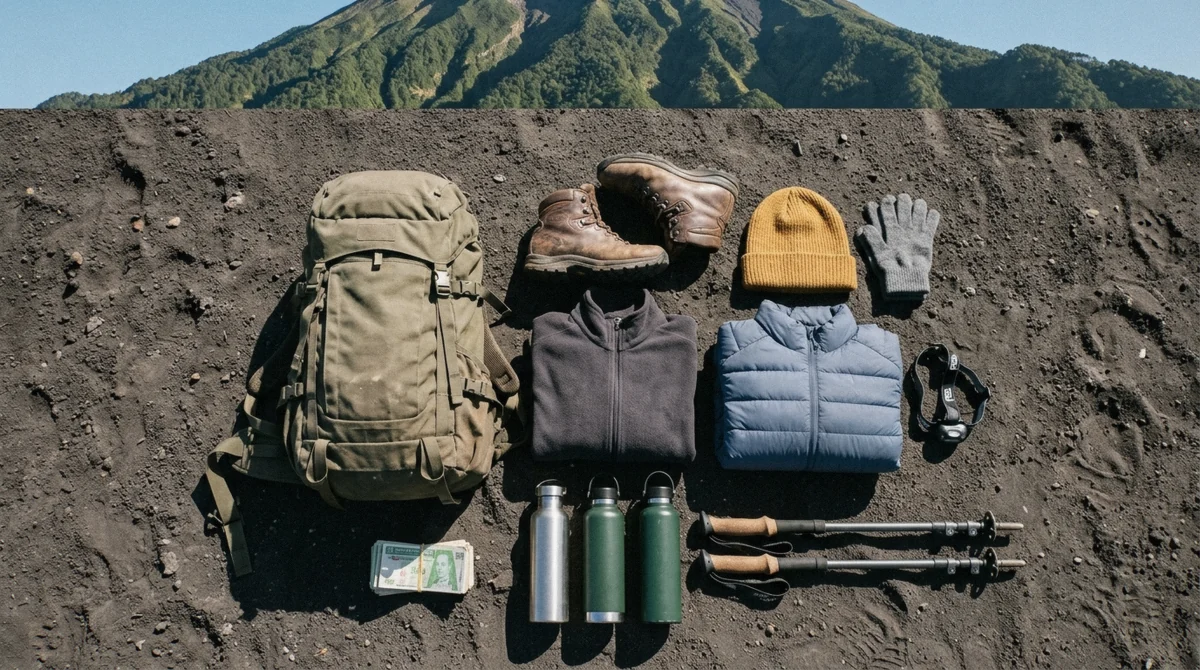
The real Acatenango packing list: three layers, real boots, a headlamp and water. Everything else is optional.
Quick answer
Tours provide the tent or cabin, sleeping bag and meals, so your own Acatenango packing list comes down to warm layers, water, a headlamp and real hiking boots, packed into a 40 litre bag at 6 to 8 kg. Antigua sits at about 26°C in the afternoon while camp at 3,750 m drops close to freezing overnight, so the packing problem is really two climates in one bag.
Key takeaways
- What's provided: tent or cabin, sleeping bag rated to -5°C or -10°C, and three meals on every tour
- What's on you: three warm layers, a waterproof shell, water, a headlamp and real boots
- The #1 warning: no sneakers and no jeans, both fail the actual conditions on the trail and at camp
- The local number: camp runs 0 to 5°C at night while Antigua hits 26°C in the afternoon
- Footwear answer: broken-in hiking boots with ankle support, non-negotiable for the descent
- Seasonal delta: December and January nights are the coldest of the year, so pack heavier layers in that window
What to Wear
Base Layer
A thermal or synthetic base layer, top and bottom, goes against your skin. Cotton is the mistake I see most at the trailhead: it soaks through with sweat on the climb, then sits wet and cold against you once you stop moving at camp. A snug but not tight fit leaves room for the mid layer over it.
Sun Protection
The climb itself is mostly shaded once you're past the first hour of open farmland, but that first hour sits at close to 2,400 m with strong midday UV. A long-sleeve shirt or sunscreen on exposed skin covers the exposed stretch; there is no reef-safe requirement here since there's no water on this trail.
Insulated Outer Layer
This is the layer most people underpack. Camp temperatures fall to 0 to 5°C in December and January, with wind chill near -10°C on the summit push, so a real insulated jacket, not a light fleece, is the difference between a comfortable night and a miserable one. Rentals in Antigua run 50 to 150 quetzales for a jacket, gloves or hat, cheap insurance against a night you can't fix once you're at camp.
Footwear
Broken-in hiking boots with ankle support are required, not optional, and this is where I turn people back most often. Sneakers and trail runners can get you up the sand slope, but they fail on the 2 to 3 hour descent, where loose sand and gravel are what end trips, not the climb up. Sandals and flip-flops are only fine for lounging around camp itself once your boots are off, never for any part of the trail.
If you don't own real boots, rent a pair in Antigua rather than buying new footwear you'll break in on the mountain itself.
Color matters less here than fabric does, but it isn't nothing. The table below covers what actually helps or hurts on this specific trail.
| Color | Good? | Why |
|---|---|---|
| White | Bad | Shows volcanic dust and trail grime within an hour and stays visibly dirty for the rest of the trip |
| Black | Good for evening | Absorbs heat, which helps once you're sitting still at a near-freezing camp; gets uncomfortably warm on the exposed climb |
| Bright or neon | Good | Easy for your guide to spot you on the trail or in low cloud near the summit push, useful in a group of 20 or more |
| Camouflage pattern | Skip | No legal restriction on this route, but it makes it harder for a guide to pick you out against loose volcanic rock at distance |
| Earth tones (brown, olive, grey) | Good | The common local choice; hides two days of trail dust without needing a wash |
| Navy or dark blue | Good for cold | Absorbs warmth similarly to black, works well layered at camp after dark |
| Cotton, any color | Bad | Stays wet and cold once damp regardless of shade; the fabric, not the color, is the real problem |
The Packing Checklist
Beyond what tours provide, here's the real list, built from what guides actually see people forget:
- Three warm layers (base, mid, insulated), wear one, carry two
- Waterproof shell jacket, cloud rolls through camp most evenings, even in dry season
- Hat, gloves and a buff, wind at camp costs more warmth than the temperature alone
- 3 to 4 litres of water, no water source above La Soledad
- Broken-in hiking boots with ankle support, the descent is where trainers fail
- Headlamp with fresh batteries, required for the 4:00 AM summit push
- Cash in quetzales, the 100 quetzal park fee is collected on the trail, no card machine
- Sugar-and-salt snacks, appetite drops at altitude, small frequent bites work better than a big meal
- Any altitude medication you already use, acute mountain sickness affects about 25% of hikers at camp
- Trekking poles, rent for 30 to 50 quetzales, real knee insurance on the descent
- Small dry bag or ziplock, keeps your phone and any cash dry if cloud turns to rain
What Tours Provide (So You Don't Overpack)
Read-out: every tour on this mountain provides the tent or cabin, a sleeping bag and meals, so most of the heavy gear is already handled before you land in Antigua. What varies is footwear rental, outer-layer rental and the porter option, and that's where the Notes column below matters.
| Item | Usually Provided | Bring Your Own | Notes |
|---|---|---|---|
| Tent or cabin | Yes, all tiers | - | Cabin standard on the small-group tour; tent standard on budget tiers |
| Sleeping bag | Yes, most tours | Rental where not included | Rated -5°C to -10°C; rents for $20 to $30 where excluded |
| Meals | Yes, all tiers | - | Three meals standard, dinner at camp and breakfast before descent |
| Transport | Yes, all tiers | - | Antigua to La Soledad and back included |
| Trekking poles | Rental, not automatic | Bring your own or rent | 30 to 50 quetzales in Antigua |
| Warm jacket, gloves, hat | Rental, not automatic | Bring your own or rent | 50 to 150 quetzales; private tour sometimes bundles this in |
| Hiking boots | Rarely | Bring your own or rent in Antigua | Ankle support required for the descent |
| Headlamp | Sometimes | Bring your own to be safe | Confirm before departure; required for the 4:00 AM push |
| Water | 1 to 2 litres typical | Carry 3 to 4 litres total | Bought at the trailhead for 20 to 40Q if you fall short |
| Porter | Never included | Hire separately if needed | 200 to 500 quetzales, usually above a 12 kg threshold |
What NOT to Wear or Bring
Sourced from what guides actually turn people back for, not generic packing-blog boilerplate.
- Jeans, they don't dry, go rigid once wet, and chafe hard on a multi-hour climb
- Sneakers or low-cut shoes, no ankle support means the sand-and-gravel descent ends badly
- Flip-flops or open sandals for the trail, fine at camp once boots are off, never on the trail itself
- Heavy cotton hoodies as your main warm layer, they soak with sweat on the climb and stay cold at camp
- A full-size tripod or extra camera gear, the trail is uneven enough without extra weight to manage
- Large bills over 100 quetzales, nobody on the mountain can break them
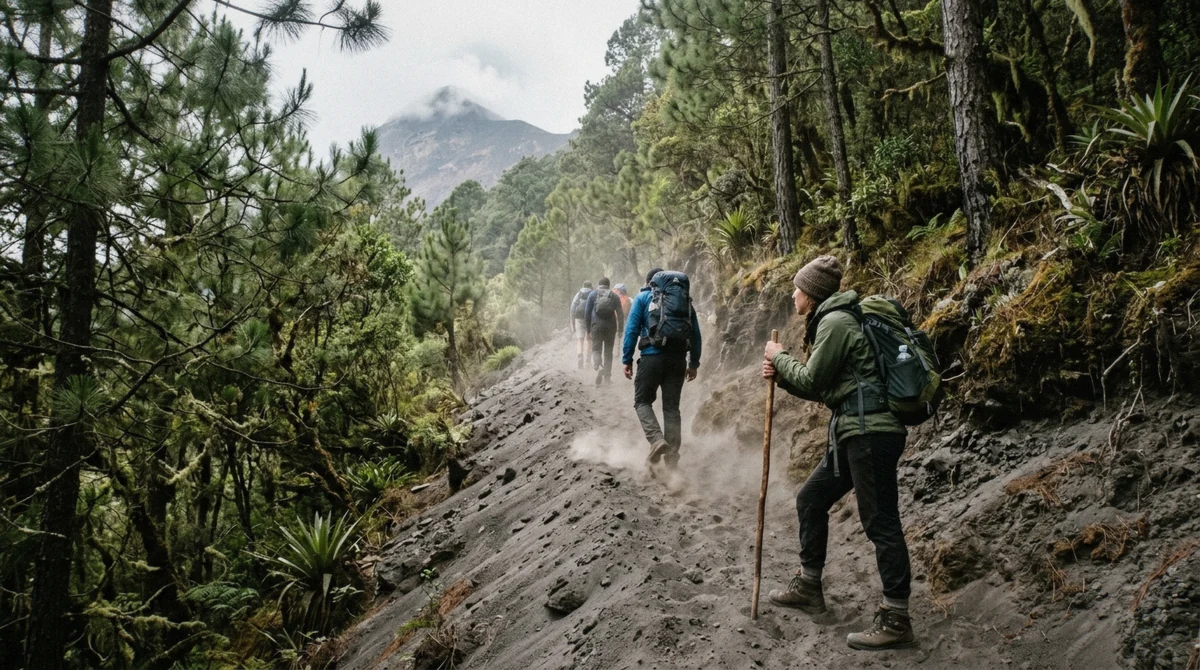
Packing by Season on Acatenango
November to April: Dry Season, Coldest Nights
This is peak booking season and also the coldest window at camp, with nights running 0 to 5°C in December and January specifically, colder than February through April. Pack your heaviest layers in this window even though Antigua's daytime temperature barely changes across the year; the gap between town and camp is what matters, not the calendar month by itself.
May to October: Rainy Season, Milder Nights
Camp nights run closer to 5 to 10°C in this window, milder than peak dry season but still cold enough for a real insulated layer. The waterproof shell earns its place here more than in dry season, since afternoon rain and cloud are common on the climb itself, not just at camp after dark.
Whatever the month, the temperature swing between Antigua's roughly 26°C afternoons and camp's near-freezing nights is the actual packing problem, not the season on the calendar. For the full month-by-month breakdown of rain, crowds and booking windows, see hikes with free cancellation.
How Heavy Your Pack Should Be, and Hiring a Porter
A 40 litre pack is the usual size for this hike, and 6 to 8 kg is a realistic loaded weight once your layers, water and snacks are in it. That weight rides on your back for the full 1,576 m of gain to camp, so cutting anything non-essential before you leave Antigua pays off directly on the trail.
A porter carries the heavy pack for you at 200 to 500 quetzales, usually priced above a 12 kg threshold, which most well-packed bags don't reach. It's worth booking ahead in Antigua rather than trying to arrange one at the trailhead, since availability on a busy weekend is limited. Full detail on what a porter and every other trail extra costs is on what each overnight hike includes.
Weighing your bag before you leave your hostel is worth the two minutes it takes. Most people overestimate how much they've packed and underestimate the water, which is usually the single heaviest item in the bag. If your loaded pack sits meaningfully above 8 kg, that's the moment to decide between cutting weight or booking a porter, not halfway up the sand slope.
Renting Gear in Antigua Instead of Buying
Renting beats buying for almost everything on this list, since most travelers use this gear once. A sleeping bag runs $20 to $30 where your tour doesn't include one, trekking poles rent for 30 to 50 quetzales, and a jacket, gloves or hat run 50 to 150 quetzales for the trip. Shops cluster within a few blocks of Parque Central, and most of the Acatenango hikes that supply the gear can point you to a rental shop directly when you book, or bundle a rental into the ticket price on request.
Booking a rental a day ahead beats hoping one is left the morning of a busy dry-season weekend, when the popular sizes go first.
What to Leave Behind
A second full change of clothes for day two, since you'll wear the same layers down that you wore up, and a shower is what fixes that, not a fresh outfit at 3,750 m. A full-size camera bag with multiple lenses, since the trail is steep and uneven enough that a phone or a single compact camera covers most people's needs without the extra weight and worry. Toiletries beyond the basics, since there's no real bathroom above La Soledad and a full wash kit is dead weight for one night. Anything you're not confident carrying uphill for 4 to 6 hours stays in your Antigua hostel, not in your daypack.
A book, a travel pillow, or a portable speaker fall into the same category. Camp is small, cold and dark after 8:00 PM, and the honest use of your energy there is watching Fuego and getting warm, not entertaining yourself with things that add weight on the way up. Extra battery packs are the one exception worth keeping, since a cold night drains a phone fast and the sunrise photos from the summit are the ones most people actually want charged.
Packing for the Summit Push Photos
The 3:30 or 4:00 AM summit push is the coldest, windiest hour of the whole trip, and it's also when most people take the photo they actually came for. Cold drains camera and phone batteries fast, so keep a spare battery or your phone in an inner jacket pocket rather than an outer one; a device that dies at 3,976 m at sunrise is the one packing mistake with no fix once you're up there. A thin liner glove that still lets you operate a touchscreen beats bare hands fumbling with a phone in the wind.
If you're shooting on a real camera, dust from the volcanic sand lower on the trail is worth a lens cloth for, since it settles into bag seams over the two-day trip more than most people expect.
Packing Questions Before You Go
How big of a backpack do I need for Acatenango?
A 40 litre pack is the standard size, big enough for three layers, water and snacks without being bulky on a steep trail. A realistic loaded weight is 6 to 8 kg, all of which rides on your back for the climb to camp.
How much water should I carry up Acatenango?
3 to 4 litres. There is no water source above the La Soledad trailhead, and most tours only provide 1 to 2 litres, so plan to carry or buy the rest before you start walking.
How do I physically prepare for the Acatenango hike?
Train for sustained uphill walking with weight on your back, not for speed. In the six weeks before you fly, walk 8 to 10 km with a loaded pack of 6 to 8 kg twice a week, and add stairs or a steep hill session once a week, because the climb is 1,576 m of gain in one afternoon with no flat recovery. Altitude is the part training cannot fix: spend two or three nights above 1,500 m first, which Antigua at 1,530 m gives you for free, and go slower than feels natural on the first hour of volcanic sand. If you already use altitude medication, bring it. The honest fitness gate and who ends up regretting the climb are covered in our verdict on the hike.
Do tours provide sleeping bags and tents?
Yes, on nearly every tour. Bags are rated -5°C to -10°C, and where a tour excludes one, renting separately costs about $20 to $30 in Antigua before you leave.
Can I wear jeans on the Acatenango hike?
No. Jeans don't dry once wet, go stiff and cold, and chafe hard over a multi-hour climb. A quick-dry base layer under a mid layer handles the same temperature range far better.
Can I wear shorts on the hike?
During the climb itself in warm weather, yes, quick-dry material only, though most hikers switch to full-length layers once the trail cools in the cloud forest and stays in them at camp for warmth overnight.
Do I need water shoes or special boots?
No water shoes, this isn't a water activity. What you need is broken-in hiking boots with ankle support, since crampons aren't involved but the loose sand and gravel on the 2 to 3 hour descent punish anything without real ankle support.
Will my phone get wet or die from the cold?
Cold drains batteries faster than usual, so keep your phone in an inner pocket rather than an outer one overnight. A small dry bag or ziplock protects it if cloud turns to light rain on the climb.
Pack the three layers, wear real boots, and let the tour handle the tent, the bag and the food. That's genuinely the whole list once you strip out what's already provided. Get the boots and the warm layer right, since those are the two things I can't fix for you at the trailhead, and the rest of this packing list takes care of itself.